
In summary
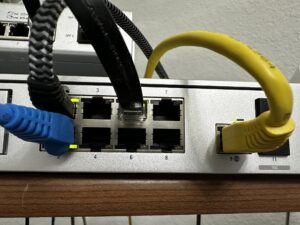
- Geography continues to decide half the service. Monitoring and support are carried out remotely, but cabling, hardware and network surveys require someone on site.
- Each region has a different company profile — and different IT problems. Lisbon cannot be resolved like Setúbal, nor Beja like Porto.
- What matters isn't the kilometres, is the real-time travel time during peak hours and the availability of replacement stock.
- Always ask how many customers does the supplier have in your area. That is what separates real proximity from leaflet proximity.
In this article
There is a part of IT support that is the same everywhere: a monitored server in Beja is monitored in exactly the same way as a server in Lisbon. And there is another part that depends entirely on where the company is located — because it involves someone walking through the door with a ladder, a cable tester or a replacement switch in their bag.
This article covers the regions where DataRoad operates, what distinguishes the business landscape in each one, and what to ask before signing an IT support contract.
What changes depending on the region
The overwhelming majority of incidents are resolved without a call-out: updates, security management, server configuration, user support, backups and almost all software faults. That doesn't change from city to city.
What changes is the rest — and the rest is precisely what happens on the worst days:
- Installation and certification of structured cabling
- Replacement of faulty hardware
- Network surveys and studies of wireless coverage
- Active equipment installation in a rack
- Interventions when the network connection itself is down — meaning the remote is useless
The right criterion is not distance. It is the real-time travel time at the hour things usually break down, and the availability of back-up equipment. Twenty kilometres in the rush hour are worth more than a hundred at lunchtime.
Lisbon
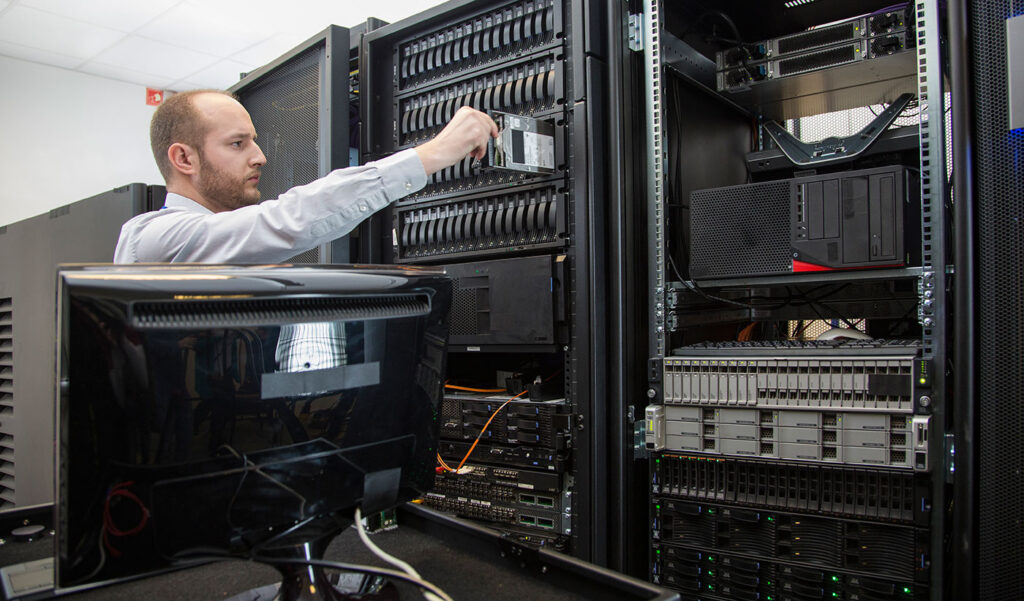
Lisbon concentrates headquarters, service offices, technology companies and a high density of SMEs with small teams and high demands. The dominant profile is the office: many users per square metre, total reliance on Microsoft 365 and email, and zero tolerance for interruptions during working hours.
The most frequent requests are for IT consultancy in Lisbon, workstation management, email security and office network reorganisation that grew without a plan. The critical point is usually the same: infrastructure put together in a hurry five years ago that nobody has looked at since.
Cascais and Oeiras
The Oeiras–Cascais corridor has a distinct characteristic: modern business parks, many international companies with headquarters outside the country, and an unusual proportion of teams on hybrid working arrangements. This pushes work in two directions — secure remote access and local network quality in shared buildings.
Um Oeiras office parks and service companies weigh heavily; in Cascais, there is greater geographical dispersion and more smaller offices spread across various locations in the municipality. In both cases, what is usually lacking is someone to treat the network as a project rather than a collection of equipment bought at different times.
Setúbal and Península de Setúbal
Setúbal, Barreiro, Almada, Seixal, Montijo and Palmela form one of the densest business networks in the country: manufacturing industry, port-related logistics, growing private healthcare and offices that have left Lisbon in search of more rational rent.
The technical profile is different from the urban office. Here, networks are required in warehouses and halls, wide-area wireless coverage with barcode scanners working without faults, and integration with production equipment that was rarely included in the initial project. IT support for businesses in Setúbal there is also a factor of its own: crossing the Tagus turns twenty kilometres into forty minutes. It is worth asking which side of the river the team that turns up is on.
Beja and the Alentejo
In the Alentejo, the problem isn't complexity — it's distance. Agro-industrial companies, cooperatives, processing plants and municipal services often operate more than an hour away from the nearest supplier, which makes on-site response expensive and slow when it isn't organised.
It is the region where remote monitoring and prevention are worth the most: detecting a failing drive before it fails saves a two-hundred-kilometre trip. To businesses in Beja, the model that works is strong remote with planned travel — and a contract that states in writing what happens when you need to go there.
Porto
In Porto and the North, the fabric is dominated by export-oriented industry, textiles, footwear, metalworking and an expanding services sector. The recurring requirement is continuity of production and the connection between manufacturing plants and offices, often in separate buildings.
The typical work of IT support for businesses in Porto it runs through networks between pavilions, link redundancy and systems that cannot go down on night shifts, when there is nobody in the office to restart anything.
How to choose a partner
Four questions that apply in any of these regions:
How many customers are there in this area? A supplier with an established portfolio in the region already has routes and availability organised. One that has an isolated client will treat them as an exception.
What is the guaranteed travel time, in writing? And measured from where, at what time.
Do you have replacement stock in stock? A broken switch on a Saturday can only be resolved quickly if there is spare equipment. Otherwise, the quick response serves only to confirm that one is waiting for the order.
What service levels Do they apply to face-to-face interventions? Many contracts commit to tight timeframes for remote support and leave on-site support without a defined deadline.
DataRoad provides managed IT services and IT support for businesses in Lisbon, Cascais, Oeiras, Setúbal, Beja and Porto, with permanent remote monitoring and support and on-site capability in each of these regions.
A chat before making a decision
Whether you’re tackling a specific problem, planning a move or simply looking for a second opinion, we always start in the same way: by understanding your situation before making any suggestions. No obligation, no jargon and no catalogues.